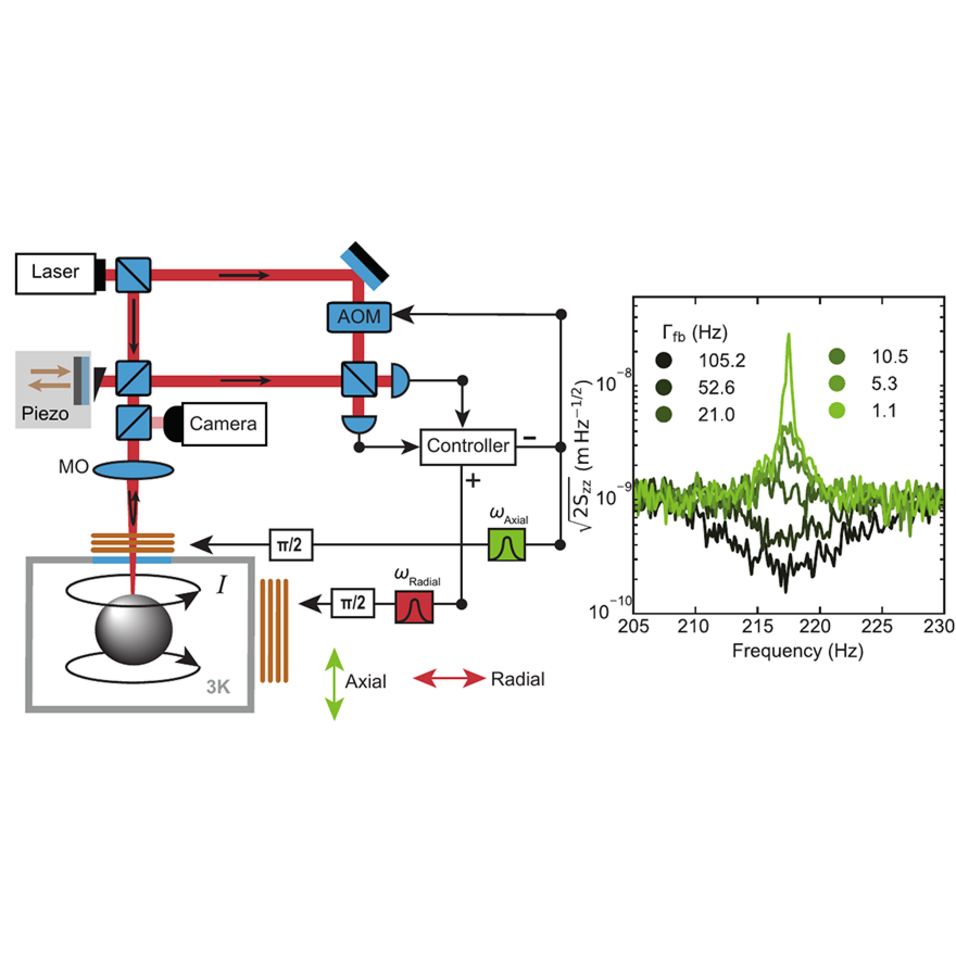
All-superconducting magnetic platforms provide virtually dissipation-free levitation with mechanical quality factors exceeding 107, making them strong candidates for quantum experiments with masses. Bringing such systems into the quantum regime via real-time control techniques, however, requires quantum limited detection sensitivity. While optical interferometry is the gold standard to achieve such sensitivities, optical absorption is typically a showstopper for using this technique with superconductors. Here we demonstrate direct optical interferometric readout of the motion of a 6-microgram magnetically levitated superconducting microsphere at 3 K, and use the measured signal to feedback-cool its motion. We achieve a displacement resolution around 1 nm/√Hz, limited not by the optical scheme but by technical noise from the particle itself.
The sphere is trapped in the field minimum of an anti-Helmholtz coil pair wound from niobium–titanium wire inside a closed-cycle cryostat, and its axial position is read out by a Mach–Zehnder-like interferometer at 637 nm with balanced homodyne detection. A phase-tracking loop on an acousto-optic modulator extends the linear response of the interferometer from the usual λ/8 dynamic range to displacements of several wavelengths, allowing the large amplitudes of the pre-cooled particle to be resolved linearly. Our noise floor is two orders of magnitude above the shot-noise limit of 11 pm/√Hz, mainly due to surface roughness on the 50-nm scale, and rotations and drifts of the particle in the trap — sources whose mitigation is technical and not fundamental to the scheme. Despite direct optical illumination, the particle remains superconducting for up to several hundred seconds.
When combined with the established toolkit of cavity optomechanics, in particular the integration of high-finesse cavity readout, this approach opens a concrete path to measurement-based quantum control of cryogenic isolated masses at the microgram scale — and, eventually, to quantum experiments probing gravitational phenomena with this platform.
Publication:
Optical Interferometric Readout of a Magnetically Levitated Superconducting Microsphere
J. J. Hansen, S. Minniberger, D. Ilk, P. Asenbaum, G. Higgins, R. G. Povey, P. Schmidt, J. Hofer, R. Claessen, M. Aspelmeyer, M. Trupke
Phys. Rev. Applied 25, 044080 (2026)