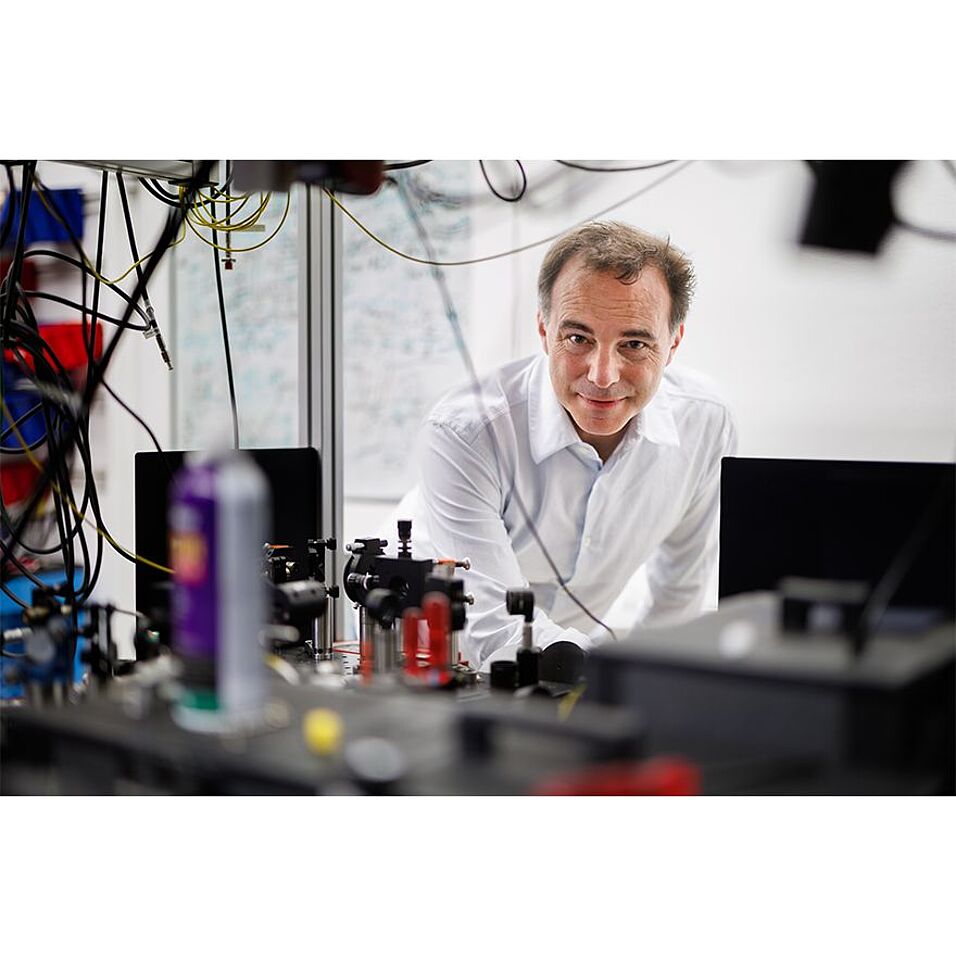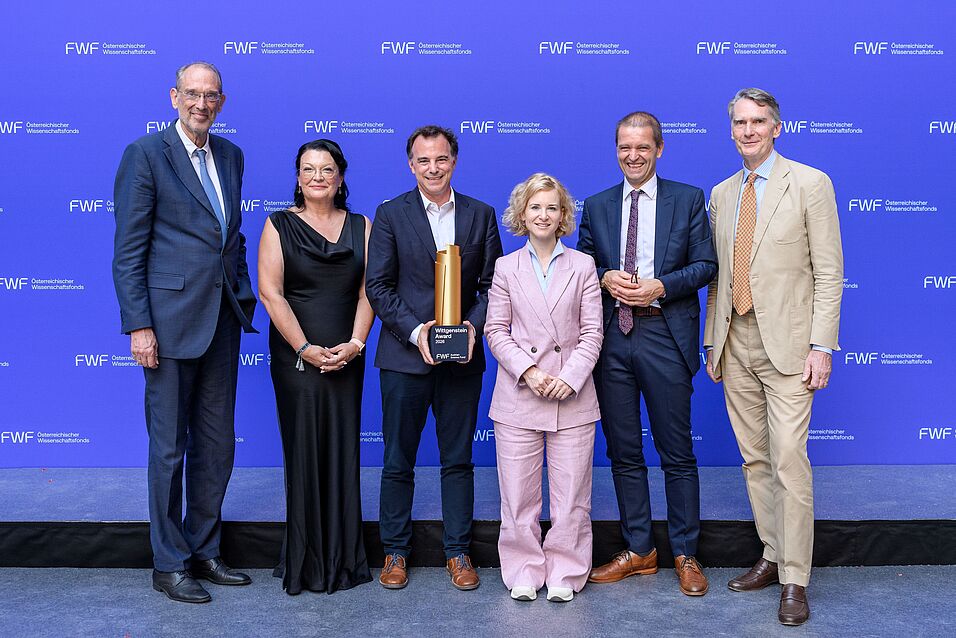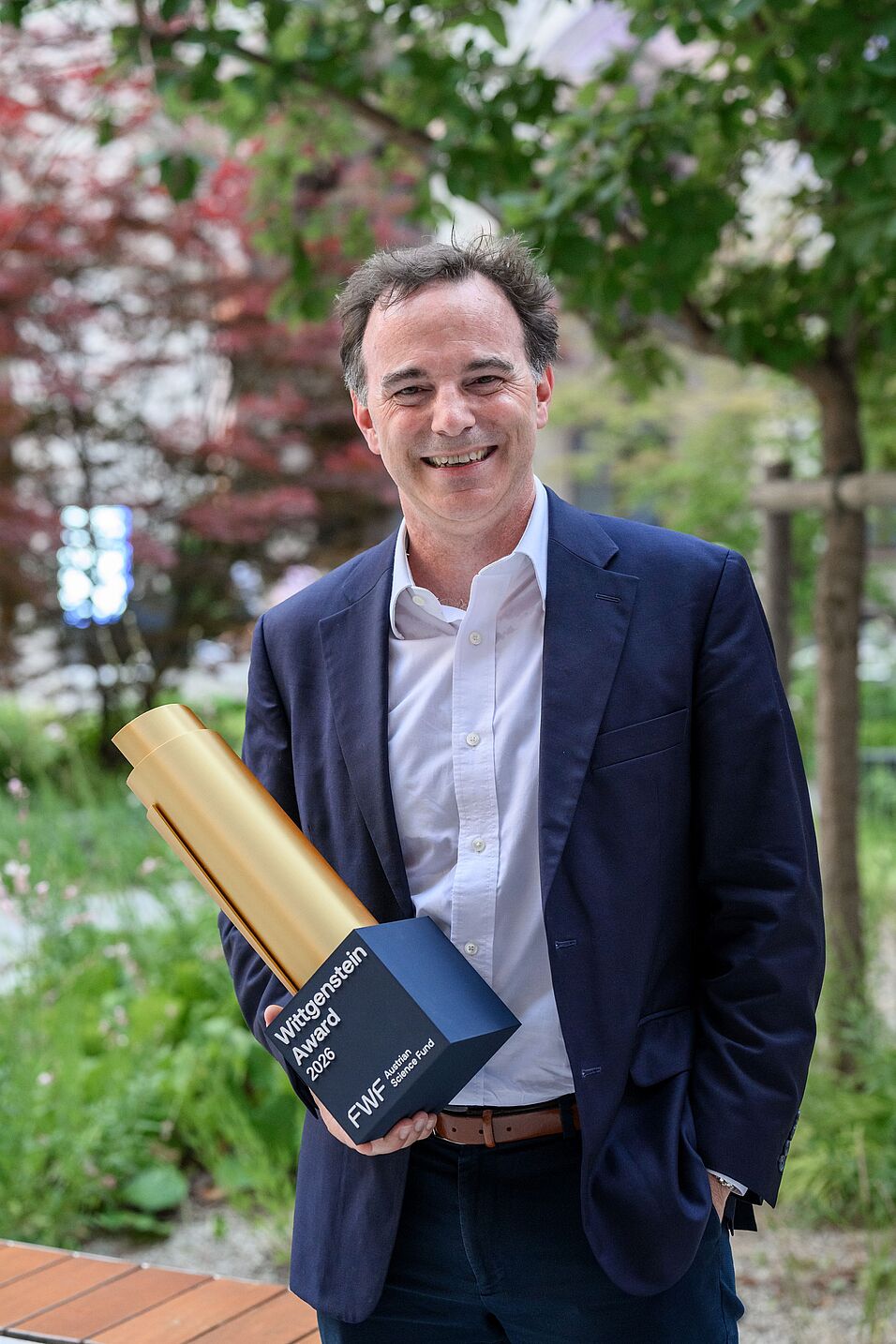
The Austrian Science Awards, Austria's most highly endowed research prizes, have been announced: Based on the recommendation of an international jury of experts, the Austrian Science Fund (FWF) has awarded the FWF Wittgenstein Award worth €2 million to quantum physicist Markus Aspelmeyer from the University of Vienna and the Austrian Academy of Sciences.
In his research, quantum physicist Markus Aspelmeyer is tackling one of the greatest scientific challenges of our time: two major theories of physics – quantum mechanics and the general theory of relativity – are incompatible. The aim of Aspelmeyer’s research is to develop experiments that could, for the first time, demonstrate how gravity and quantum physics actually interact.
“The FWF Wittgenstein Award is a great recognition of the collective achievements of our entire team, and gives us a strong motivation for our future work. This funding will allow us to continue our experiments at the University of Vienna and the Austrian Academy of Sciences at full power over the long term, and to commit all our strength to tackling key open questions at the interface of quantum physics and gravity. I am very much looking forward to the upcoming years,” said Markus Aspelmeyer.
“In selecting Markus Aspelmeyer for this award, the international jury is honoring a scientist whose work in basic research addresses one of the great unresolved questions in physics: the connection between quantum physics and gravity. New experimental results are urgently needed to further our understanding of the laws of nature at the interface of these two mainstays of physics. These experiments are extremely challenging, and Markus Aspelmeyer’s team continues to push the boundaries of what is technically possible. The international jury’s selection confirms Austria’s role as a global pioneer in the field of quantum research,” said FWF President Christof Gattringer.
“My congratulations to Markus Aspelmeyer on this outstanding achievement. He has been conducting excellent basic research for years and has played a key role in making Austria a leading international center for quantum physics. This success also highlights the importance of adequate funding for basic research for the FWF and our universities. To ensure Austria's position as a research nation, we need planning certainty, a clear commitment from the federal government to support internationally competitive universities, and sufficient funding for 2028–2030,” said Sebastian Schütze, Rector of the University of Vienna.
Between Einstein and the Quantum World: New Experiments on Gravity
Two of the most important theories in modern physics describe the world remarkably well, but are incompatible: quantum mechanics and the general theory of relativity. The question of how to reconcile these two theories with each other is one of the greatest scientific challenges of our time. The general theory of relativity, developed by Albert Einstein more than 100 years ago, explains gravity. It describes how mass curves space and time, generating the gravitational force that keeps planets in their orbits or causes black holes to form. To this day, the theory provides precise predictions for all phenomena related to gravity, from gravitational waves to the time dilation caused by Earth’s gravity.
Quantum mechanics, on the other hand, describes the world of the smallest particles. Unlike in classical physics, particles do not move along precisely defined paths, but are described in terms of probabilities. They can exist in multiple states at the same time and exhibit behaviors that contradict our everyday experience. And yet, quantum mechanics has been confirmed by countless experiments over the past 100 years and forms the basis for modern technologies such as semiconductor chips, lasers, quantum sensors, and quantum computers. The problem: Both theories work exceptionally well in their respective fields while remaining fundamentally at odds with each other. The theory of relativity describes space and time as fixed quantities, while quantum mechanics suggests that spacetime, too, must exist in a superposition and depend on the observer. We still don’t know which one of these views is correct.
This is precisely where the research conducted by Viennese quantum physicist Markus Aspelmeyer and his team comes in. Their goal is to develop experiments that could, for the first time, demonstrate how gravity and quantum physics actually interact.
The researchers are investigating how small a mass can be and still have a measurable gravitational field, and at the same time, how large objects might behave according to the laws of quantum physics. The researchers have already succeeded in measuring the gravitational field of a gold sphere just one millimeter in diameter – an effect that is about 30 billion times weaker than Earth’s gravitational pull. In highly specialized laboratories, glass particles the size of a grain of sand are controlled using light in a vacuum and brought into quantum states. In the long term, these experiments are intended to show whether gravity also follows the laws of the quantum world. If successful, this work could provide crucial evidence for a theory of quantum gravity, leading to a deeper understanding of the fundamental laws of nature in our universe.
About Markus Aspelmeyer
Markus Aspelmeyer is one of the world’s most renowned researchers in the field of quantum optics and quantum optomechanics. After studying physics and philosophy, he earned his doctorate in physics from Ludwig-Maximilians-Universität München in 2002. The Bavarian native then moved to the University of Vienna, where he worked in the research group of Nobel laureate Anton Zeilinger. Aspelmeyer has been a professor of physics at the University of Vienna since 2009 and, since 2019, has also served as director of the Institute for Quantum Optics and Quantum Information (IQOQI) in Vienna, part of the Austrian Academy of Sciences. He is a member of the Board of Directors of the Cluster of Excellence “Quantum Science Austria,” which is funded by the FWF. Aspelmeyer is one of the pioneers of quantum optomechanics. Together with his team, he is researching quantum phenomena in entirely new fields. His current work contributes significantly to our understanding of the boundaries between quantum physics and gravity.
The 52-year-old researcher has received numerous awards for his scientific achievements, including the FWF START Award, the Ignaz L. Lieben Award, and the Berthold Leibinger Innovationspreis. In 2025, he was awarded the European Physical Society’s Prize for Fundamental Aspects (EPS-QEOD Prize) for his groundbreaking contributions to quantum optomechanics. The three-time ERC grant winner is, among other things, a Fellow of the American Physical Society and a member of the Austrian Academy of Sciences as well as the Academy of Sciences and Humanities in Hamburg.
“Congratulations to Markus Aspelmeyer and his team! As one of the world’s leading quantum researchers, his experiments focus on one of the still-unresolved questions of modern physics. His findings have the potential to significantly expand our understanding of the laws of nature and to spur innovation in the long term. With his research at the University of Vienna, the Austrian Academy of Sciences, and the Cluster of Excellence quantA, he is adding another promising chapter to the internationally recognized success story of the Austrian quantum community,” said Minister of Science Eva-Maria Holzleitner.
“Markus Aspelmeyer is a well-deserved winner of the Wittgenstein Award. He is a leading figure in quantum physics whose influence in the entire scientific community extends far beyond the Austrian Academy of Sciences. His success clearly demonstrates the importance of strong OeAW institutes, as they help shape Austria’s research priorities and provide an attractive environment for the world’s top researchers. I would like to extend my warmest congratulations to Markus Aspelmeyer,” said Heinz Faßmann, President of the Austrian Academy of Sciences.
Jury statement: A New Chapter in Austria's Quantum Research
“At the heart of Markus Aspelmeyer's work lies one of the most profound questions in physics: Can gravity itself possess quantum mechanical properties? Positive experimental evidence would not disprove Einstein's theory of relativity, but would demonstrate for the first time that gravity can carry quantum information. If this can be proven, it could fundamentally change our understanding of nature – much like the experiments on quantum entanglement that were honored with the Nobel Prize in Physics in 2022. This year’s FWF Wittgenstein Award not only recognizes Markus Aspelmeyer’s outstanding scientific career, but also represents an investment in one of the most ambitious projects in modern physics, adding another promising chapter to Austria’s successful tradition in quantum research,” according to the international FWF jury.
The ASTRA/Wittgenstein jury is made up of 16 international researchers who are all leading experts in their fields. The jury is chaired by Lino Guzzella, former president of ETH Zurich. A list of the members of the ASTRA/Wittgenstein jury is available on our website.
FWF Wittgenstein Award: Austria’s most highly endowed science prize
The FWF Wittgenstein Award is granted to outstanding researchers from all disciplines. The award, endowed with €2 million, supports the researchers’ work and guarantees them independence and flexibility in implementing their projects, giving them the opportunity to advance their research activities at the highest international level.
further articles here:
Quantum Research at the University of Vienna